Short answer
Monosodium urate crystals make gout possible, but the flare is the immune system turning that crystal setting into inflammation. Complement, NLRP3, IL-1 beta, and neutrophils help explain why the joint can become hot, swollen, stiff, and intensely painful so fast. If you are in pain now, use the flare-now guide; if this is a first flare, feverish joint, wound, trauma, severe illness, immune suppression, or a different pattern, get same-day medical evaluation because infection and injury can look similar.
Evidence label: crystals and inflammatory flares are current-care gout facts; the complement/NLRP3 cascade is mechanism evidence that keeps the body story honest.
Crystals make a gout flare possible. The immune system makes it hurt.
People hear "crystals" and imagine tiny shards scraping the joint. That image is vivid. It is also incomplete.
The flare is inflammation. It is the immune system reacting to urate crystals as danger.
Why this framing is solid:
- Current care: gout involves urate crystals, sudden painful inflammatory flares, and treatment categories that lower inflammation or lower urate over time.
- Mechanism evidence: crystal deposition, complement priming, NLRP3 activation, IL-1 beta signaling, neutrophils, and resolution.
- Practical use: separating crystals from flares keeps pain relief and long-term prevention from getting mixed together.
Crystals are the substrate
When serum urate stays high enough for long enough, urate crystals can form in joints, tendons, and surrounding tissue.
Those crystals can persist between flares. Pain going away does not prove the crystal burden is gone. It usually means the acute inflammatory episode has resolved.
That is why gout can feel like a strange ambush. The joint may be quiet for weeks, months, or years. Then something changes: urate shifts, local tissue stress, dehydration, illness, alcohol, fasting, injury, or another signal. The immune system notices the crystal context and lights up.
Crystals are not destiny
Many people have hyperuricemia without gout symptoms. Some people have deposits that stay quiet for long stretches. Some people flare repeatedly from the same joint.
The difference is not only the existence of crystals. It is the state of the tissue and immune system around the crystals.
This is the prepared-system idea. A flare can look like it came from one meal or one beer or one long walk. Sometimes that event mattered. But it usually landed on top of a system that was already prepared: urate burden, crystal deposits, local irritation, and immune priming.
How the immune cascade turns on
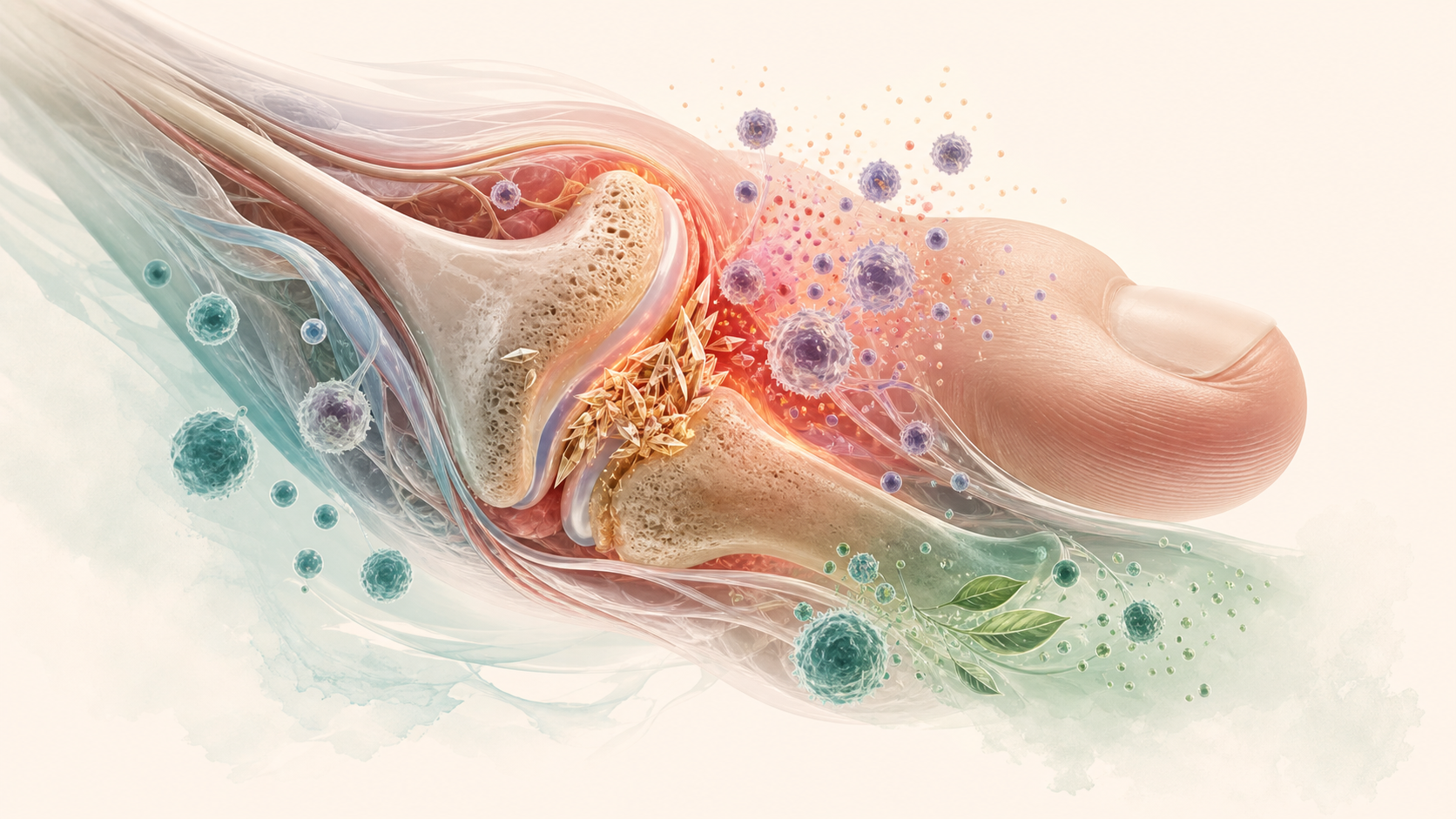
A gout flare is innate immunity doing its job in the wrong context.
The useful version is not a full immunology lecture. It is the sequence that explains why a quiet joint can become unbearable.
- Urate crystals sit in or around the joint.
- The crystals can activate complement and generate C5a, an early priming signal.
- Macrophages take up crystals and sense danger.
- NLRP3 turns on inside the immune cell.
- IL-1 beta is released.
- Neutrophils arrive and amplify inflammation.
- The joint becomes hot, swollen, red, stiff, and intensely painful.
This is why the pain can feel absurdly out of proportion. The body is not politely reacting to a small irritant. It is running an emergency inflammatory program inside a tight joint.
The cascade overlaps
The flare is not one switch flipping on and then off. It has overlapping phases.
| Phase | Usual time scale | What is happening |
|---|---|---|
| Onset | minutes to hours | crystals help activate complement and C5a; immune cells get primed; early potassium-efflux and danger signals begin |
| Amplification | hours to days | NLRP3 assembly, IL-1 beta signaling, neutrophil recruitment, LTB4 signaling, and inflammatory cell exit can make the flare feel explosive |
| Resolution | days | specialized pro-resolving mediators, neutrophil cleanup, and tissue recovery help the joint wind down |
The important part: these phases are not perfectly separate. NLRP3 can begin during onset and drive amplification. Neutrophils can amplify inflammation and later become part of cleanup. That is why a tool that helps one phase may not solve the whole flare, and why "pain is lower" is not the same as "the joint is recovered."
Evidence label: this is mechanism-map evidence. It helps explain why onset, amplification, and resolution need different jobs, but it is not a do-it-yourself treatment sequence.
Complement is an early signal
Most simple gout explanations jump straight from crystals to NLRP3. Mechanism evidence adds an important upstream step: complement.
Monosodium urate crystals can directly activate the complement system. C5a can prime macrophages before the inflammasome fully assembles. That matters because it gives us a better map of where anti-inflammatory levers overlap and where they diverge.
If two interventions hit the same chokepoint, they may be redundant. If they hit different points in the cascade, they may be additive. That is the difference between an intentional map and a random stack.
Evidence label: complement activation is mechanism evidence with gout-relevant human and animal literature. Turning that into an intervention choice belongs in the intervention map, not in a guess at the bedside.
NLRP3 is the central amplifier
NLRP3 is a danger-sensing complex inside immune cells. In gout, it acts like an inflammatory amplifier.
The crystal gets engulfed. The cell senses damage. NLRP3 assembles. IL-1 beta gets released. Neutrophils arrive. The flare escalates.
This also explains why some established gout medicines are more targeted than people realize. Colchicine is often described as a general anti-inflammatory, but mechanism evidence tracks it as an immune-cell movement and assembly modulator that interferes with NLRP3-related signaling and neutrophil movement.
The practical lesson is bigger than any one medicine: flare tools and prevention tools are different. One interrupts inflammation. The other lowers the urate and crystal burden that made the flare possible.
Current-care flare categories include NSAIDs, colchicine, corticosteroids, cold therapy, joint protection, and selected specialist IL-1 use. For action, use the flare-now guide; for the medication-category map, use the medications guide.
Why lowering urate can still be bumpy
Long-term urate control is how crystals dissolve. That is good. But changing crystal deposits can also provoke flares during the early phase of urate-lowering therapy.
This is one reason clinician-guided prevention often includes anti-inflammatory coverage when urate-lowering therapy starts or changes. The goal is not just "drop the number." The goal is to get below target and stay there while managing the transition from crystal-loaded tissue to less crystal-loaded tissue.
This is also why short-term pain relief and long-term gout control can get confused. A joint can hurt less while the crystal burden remains. A prevention plan can be working while the early months still require flare protection.
Evidence label: transition flares during urate-lowering starts or changes and anti-inflammatory coverage are current-care planning topics. The crystal-shift explanation is the mechanism that makes the plan make sense.
Questions that make this concrete:
- What serum urate target are we treating to?
- Does my crystal burden or flare pattern argue for a lower target?
- When should serum urate be rechecked?
- What anti-inflammatory coverage fits my risks while urate-lowering therapy starts or changes?
What this means during a flare
If you are in pain now, the immediate question is state fit.
- Is this your usual gout pattern?
- Is this the same kind of joint, same onset, same symptoms, same response pattern?
- Do you already have a written rescue plan that fits this pattern?
- Is there fever, chills, a wound near the joint, recent trauma, severe illness, immune suppression, or a pattern that feels different?
Those details matter because infection, injury, and other inflammatory arthritis can look like gout from the outside.
For a routine, recognized flare, the work is inflammation control, joint protection, and documentation. For a first flare or a flare with fever, chills, a wound near the joint, recent trauma, severe illness, immune suppression, or a pattern that feels different, the action changes: get same-day medical evaluation. Infection and injury can mimic gout.
What to track after it settles
The flare itself is data.
- Which joint?
- How fast did it start?
- How severe was it?
- What possible context came before it?
- What rescue did you use?
- How quickly did it respond?
- Did it rebound when you walked, trained, drank, fasted, traveled, or changed medication?
- What was serum urate after the flare settled, and should it be repeated if the in-flare value was normal or unknown?
That record helps separate three different questions:
- What triggered this event?
- What crystal burden made the event possible?
- What long-term plan should lower the probability of the next one?
Use this distinction when choices get mixed together
Separate the crystal problem from the flare problem before deciding what to do.
- Pain-now tools try to interrupt inflammation and protect the joint.
- Long-term prevention tries to lower urate below target so crystal burden can fall.
- A trigger log explains what tipped this flare, not whether the crystal problem is solved.
- Pain dropping means the inflammatory episode is quieter. It does not prove the joint is recovered or crystal-free.
- Repeated same-joint flares, slow recovery, tophi, or frequent flares belong in a prevention-review conversation.
Where to go next
- If you want the upstream number, read how uric acid works.
- If you want to understand trigger stories, read how triggers work.
- If you want to map interventions to chokepoints, use the intervention map.
- If you are in pain now, use the flare-now guide.
- If you are trying to prevent the next one, read preventing the next flare.
- If you want to turn the event into a better appointment, use the visit-prep guide.
Sources and deeper reading
Mechanism source links:
Standard-care baseline anchors checked for this draft: