A stack is not a plan. A plan knows the job.
Short answer
A gout intervention only makes sense if you can answer five questions: what state am I in, what job is this supposed to do, how strong is the evidence, what product or medication fit issue matters, and what signal will I track? Current care covers flare treatment, urate-lowering therapy, treat-to-target monitoring, and clinician-guided medication choices. Products, supplements, foods, topicals, and frontier ideas belong on the map too, but only when the job and tracking signal are clear. If you are in pain now, use the flare-now guide, because an intervention map is not a rescue plan.
Evidence label: guideline-backed medicine categories and urate targets are current care; ABCG2, BHB, uricase, NLRP3, IL-1 beta, and neutrophils are mechanism or frontier evidence unless a clinician has made them part of your actual plan.
The useful move is not "what should I add?" It is "what problem am I solving?"
First choose the job
I am trying to calm an active flare
The job is inflammation control, joint protection, sleep, and preventing rebound.
Current-care options include medicine categories such as NSAIDs, colchicine, corticosteroids, cold therapy, joint protection, and selected specialist IL-1 use. Anakinra is the practical IL-1 name to know for recurrent or hard-to-fit flares when usual categories fit poorly. The right category depends on the plan already written for you and on kidney, stomach, bleeding, blood pressure, diabetes, infection, interaction, and other fit issues.
Track: pain, swelling, heat, touch sensitivity, sleep, mobility, rescue timing, and rebound after walking or training.
Step back: first flare, fever, chills, wound near the joint, recent trauma, severe illness, immune suppression, or a pattern that feels different belongs in same-day medical evaluation.
Evidence label: flare-medicine categories are current care. The NLRP3, IL-1 beta, and neutrophil story explains why those categories help, but it does not create a do-it-yourself prescription.
I am trying to prevent future flares by lowering crystal burden
The job is to get serum urate below target and keep it there long enough for crystal burden to fall.
Current care is treat-to-target urate lowering, follow-up lab monitoring, and a flare-protection plan when urate-lowering therapy starts or changes. Standard guidance commonly uses below 6 mg/dL as the central target, with lower targets considered in some higher-burden patterns such as tophi, chronic gouty arthritis, or frequent flares despite reaching below 6.
Track: serum urate trend, flare dates, joints involved, rescue use, kidney function context, and whether the plan is actually reaching the target.
Step back: do not treat one painless week as proof the crystal problem is gone. Pain relief and crystal dissolution are different jobs.
Evidence label: treat-to-target urate lowering is current care. How crystals dissolve over time is chemistry and mechanism support for the care plan.
I am trying to understand a trigger
The job is to find a repeatable pattern without turning one meal into a life sentence.
Alcohol, concentrated fructose, dehydration, fasting, illness, sleep loss, mechanical stress, medication changes, and hormone shifts can all matter. But a trigger usually lands on a prepared system: urate burden, crystals, local tissue stress, and immune priming.
Track: the forty-eight hours before the flare, the joint, baseline, pain jump, alcohol, concentrated fructose, dehydration, fasting or ketosis, illness, sleep, injury, training load, medication or supplement changes, serum urate if available, rescue response, and rebound.
Step back: if you are changing five things at once, you may still help yourself, but you will learn less. When life allows it, test one lever at a time.
Evidence label: alcohol, purine-rich foods, high-fructose drinks, medicines, and comorbidities are current-care risk context. A personal trigger log is n-of-1 evidence, useful for your next decision but not universal proof.
I am trying to evaluate a supplement, food, topical, or product
The job is not to find a magical gout product. The job is to decide whether a specific thing has a believable mechanism, enough evidence for the claim, acceptable quality, and a trackable outcome.
Ask these before you buy or add it:
- What is the active thing: ingredient, dose, route, extract, strain, molecule, or device?
- What job is claimed: urate production, kidney clearance, gut clearance, immune priming, pain, sleep, resolution, or tracking?
- What evidence tier supports that exact claim: human gout data, human adjacent data, animal/lab mechanism, mechanism extrapolation, n-of-1, or research frontier?
- What quality issue could break the claim: contamination, wrong extract, missing active compound, dose mismatch, route mismatch, third-party testing, label ambiguity, legal status, or interactions?
- What signal will I track, and what would make me stop?
Concentrated fructose is a first-tier behavioral lever when the exposure exists. It targets urate production upstream through fructose metabolism, especially soda, high-fructose corn syrup, large sweet drinks, and fruit juice. Treat it like a real intervention: state the mechanism, change the exposure, track the signal, then decide whether it mattered.
Examples:
- Concentrated fructose reduction fits trigger testing and urate-production load. Track serum urate trend and repeat flare pattern.
- Fiber, butyrate, and ABCG2 fit gut-clearance prevention experiments. Track serum urate, stool and gut tolerance, and flare frequency.
- Tart cherry, omega-3, carnosine, sulforaphane, cannabinoids, terpenes, mushrooms, and topicals can be worth evaluating when the exact claim, product quality, and signal are clear.
- BHB, fasting, and ketosis are state-dependent. BHB has an NLRP3 mechanism story, while ketosis can transiently raise serum urate. That makes this prevention or research-state territory, not pain-now rescue.
Step back: stop treating "natural" as the safety label. Route, dose, quality, legality, interactions, comorbidities, and your actual response matter.
I am trying to make urate clearance work better
The job is to help urate leave the body instead of only asking what you ate.
Most people with gout are not making outrageous amounts of uric acid. More often, the body is not clearing enough of it. That can happen through the kidneys, through the gut, or because another medication or body state is changing the handling system.
Think of clearance in three practical lanes:
- Kidney lane: kidney function, stone history, hydration, diuretics, aspirin, blood pressure medicines, uricosuric medicines, and whether more urate in the urine would create a stone problem.
- Gut lane: ABCG2, fiber, butyrate, gut inflammation, antibiotics, and research ideas that try to move or break down urate inside the gut.
- System lane: insulin resistance, alcohol, concentrated fructose, rapid weight change, hormone shifts, and medication changes that can alter the whole urate balance.
Do not start with transporter trivia. Start with the pattern:
- Is serum urate staying high even when diet is not the obvious explanation?
- Did urate or flares change after a new medication, hormone change, weight change, antibiotic, gut issue, or kidney-function change?
- Do you have kidney stones or a history that makes "push more urate into urine" a bad fit?
- Are you already below target, or are you still above the crystal-forming range?
Track: serum urate values with dates, eGFR or creatinine, kidney-stone history, medication and hormone timeline, hydration pattern, alcohol and concentrated-fructose exposure, major gut changes, and flare dates.
Useful questions to bring forward:
- "Do my labs look more like an under-clearance problem, an overproduction problem, or both?"
- "Does my kidney function or stone history change whether a uricosuric option could fit?"
- "Could any current medication or hormone change be making urate clearance worse?"
- "Would FEUA or urine uric acid testing change the plan, or is serum urate trend enough for now?"
Evidence label: kidney labs, stone history, and medication-fit questions are current-care context. Gut-clearance ideas such as ABCG2, fiber, butyrate, and gut-lumen urate breakdown are mechanism or research-frontier leads until a specific intervention has measured human outcomes.
The "good stress" lever: training the urate-handling machinery
There is one mechanism worth understanding on its own, because it ties several everyday habits together under a single lever and because it is easy to misuse.
Your gut ABCG2 export pump and your antioxidant defenses are not fixed settings. They respond to signals. One of the strongest signals is a mild, repeated stress that tells the body to build its protective machinery up, the same way training is a stress that makes muscles stronger. The technical name is the Nrf2 response. When Nrf2 turns up, the body increases its own protective enzymes and, in animal models of high uric acid, raises gut ABCG2 so more urate leaves through the gut.
The lever is the repeated mild stress itself, not any one food. Three ordinary habits are just different ways to deliver it:
- Green or black tea, through its polyphenols. Green tea's main one is EGCG; black tea's are theaflavins, formed as the leaf oxidizes. They touch slightly different points and look additive rather than redundant.
- Broccoli sprouts, through sulforaphane, the most-studied dietary Nrf2 inducer.
- Exercise, the original good stress.
The dosing logic follows from that. A small stimulus, repeated, is the signal that trains the system up. The same compounds delivered as one large concentrated dose are no longer that signal, which is part of why the extract behaves differently from the cup below.
The dose-and-chronicity catch is the whole game here, and it connects directly to one of the common traps below: ABCG2 induction and ABCG2 inhibition are opposite moves. The favorable, export-raising effect shows up at ordinary dietary or chronic exposure, a cup of tea, a serving of sprouts, a regular walk. At the very high concentrated doses found in some extract pills, the same compounds can flip to blocking the export pump in the lab, and high-dose green-tea extract carries a documented liver-injury signal serious enough that food-safety regulators set an 800 mg/day EGCG ceiling. So this is a lever where "the cup helps" and "more is better" are not the same sentence.
Place it on the map honestly: target is increased urate clearance through the gut, with a side effect of a calmer inflammatory baseline; evidence tier is animal/lab plus mechanism for the gout-specific urate claim, with human-adjacent evidence for tea and sprout consumption generally. It is a promising, low-risk daily habit, not a proven gout treatment.
Evidence label: animal/lab and mechanism evidence for the Nrf2 and gut-ABCG2 urate lane; human-adjacent for tea and sprout consumption; the high-dose extract caveat is a documented safety boundary, not a mechanism guess.
I am trying to use the research frontier
The job is to place each research lead on the gout system before deciding what question it creates.
Frontier research matters because it shows where the gout system can be changed. Gut-lumen uricase, engineered organisms, direct NLRP3 drug development, repurposed-drug hypotheses, genotype-informed workflows, and pipeline therapies are not random trivia. They point at real chokepoints: urate production, urate clearance, crystal burden, immune priming, IL-1 signaling, neutrophil amplification, and resolution.
Examples worth recognizing by name, as of this source check: newer URAT1 inhibitors, systemic uricases such as PRX-115, selected IL-1 biologics such as canakinumab or genakumab, acute-flare candidates such as ABP-745, and repurposed-drug hypotheses such as disulfiram, zileuton, lesinurad, and pentostatin. Direct NLRP3 stories belong on the watchlist because NLRP3 is a real flare chokepoint.
The patient action is not passive waiting. It is research literacy:
- place the idea on the body map: urate, crystals, immune priming, flare signaling, resolution, or tracking
- ask what evidence exists now: human gout, human adjacent, animal/lab, mechanism, trial, or hypothesis
- search the name in ClinicalTrials.gov or ask a specialist where it sits
- ask what labs, risks, route, access, exclusion criteria, and monitoring decide fit
- watch for the moment a research idea becomes a real option, a trial, or a better clinician question
Track: the idea, the target, the evidence tier, trial status, access route, and the question it creates. If the intervention is actually available, legal, quality-controlled, and part of an appropriate care or study context, then track personal outcomes too.
Evidence label: research-frontier does not mean useless. It means the idea is a lead, not a finished consumer instruction. People deserve to know the frontier exists and exactly where it touches the gout system.
Keep the body target visible
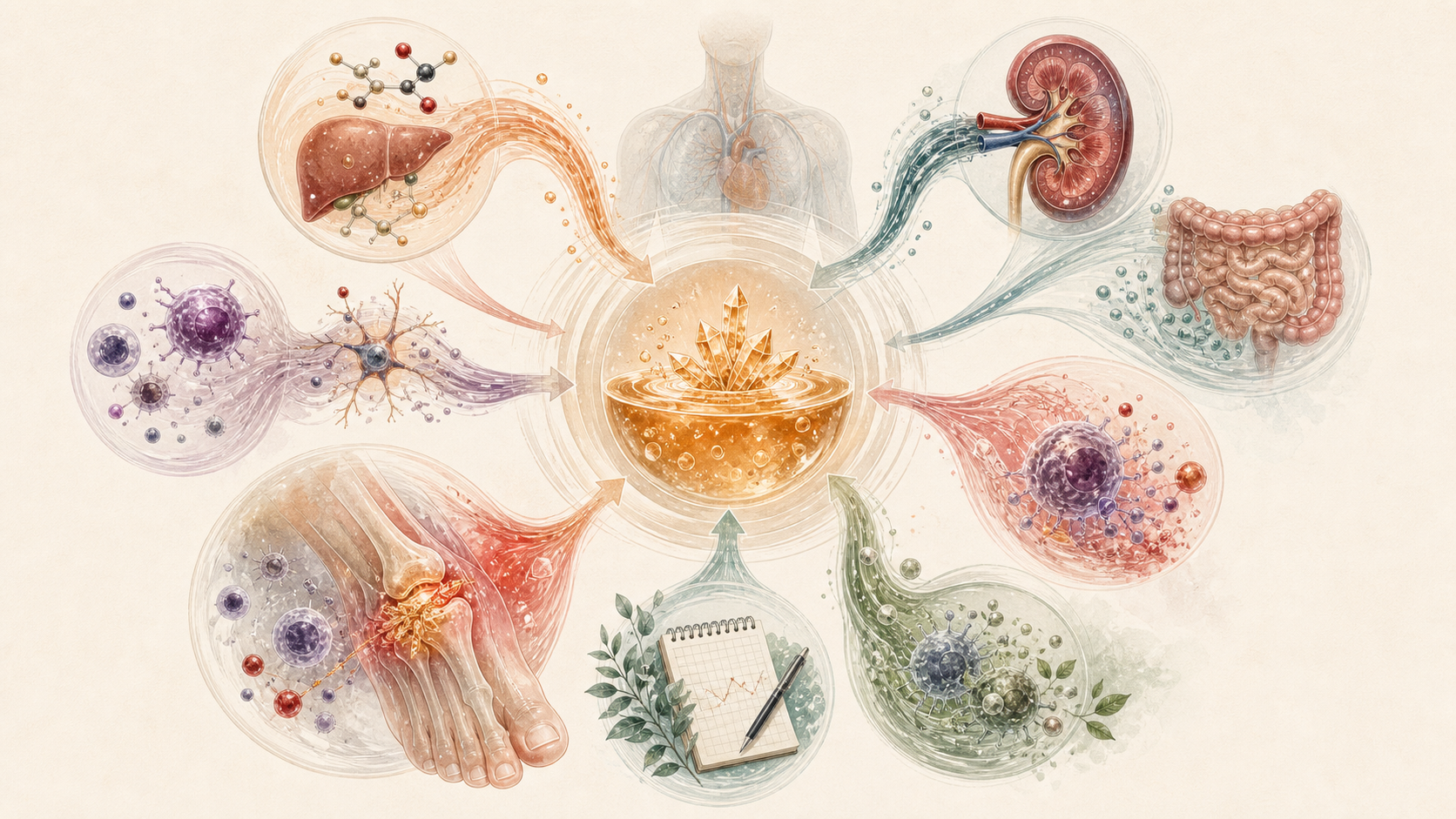
Every intervention should point to one main target:
- lower uric acid production
- increase uric acid clearance
- reduce crystal formation or help deposits dissolve over time
- reduce immune priming around crystals
- interrupt inflammatory signaling during a flare
- reduce neutrophil amplification and support resolution
- protect the joint and preserve a useful record
If you cannot name the target, you probably cannot tell whether the intervention worked.
The flare-side targets also have timing. Onset, amplification, and resolution overlap, but they are not the same job. Complement and C5a belong early. NLRP3 and IL-1 beta can start early and then drive amplification. Neutrophils can amplify inflammation and later take part in cleanup. SPMs and other resolution signals belong to the wind-down phase. That is why an intentional plan separates "interrupt the flare," "avoid rebound," and "recover the joint" instead of treating every anti-inflammatory idea as the same move.
Evidence label: this is mechanism-map evidence. It helps place interventions by job and timing; it does not turn a pathway diagram into a prescription plan.
Evidence tiers should sound clear, not timid
Use these labels close to the claim:
- Current care: guideline, label, or standard clinical category.
- Human gout data: measured in people with gout for a relevant endpoint.
- Human adjacent data: people were studied, but the endpoint or population is not exactly gout.
- Animal/lab mechanism: gout, hyperuricemia, cell, or biochemical model; human effect still open.
- Mechanism extrapolation: a plausible chain built from supported pieces.
- N-of-1 observation: useful personal signal, not general proof.
- Research frontier: development or hypothesis, not a current patient tool.
Clear evidence labels protect good ideas. They let the page talk about mechanisms without pretending that every mechanism is proven care.
Common traps
- Flare relief is not prevention. Pain dropping does not prove urate is below target or crystals are dissolving.
- Urate lowering can create transition flares because existing deposits are changing.
- Additive and redundant are different. Same-target levers may overlap; different-target levers may add.
- Gut, kidney, blood, immune-cell, and topical joint mechanisms are different places. Do not mash them together.
- ABCG2 induction and ABCG2 inhibition can be opposite moves depending on context, timing, and dose.
- Direct NLRP3 inhibition, NF-kB priming, P2X7 signaling, complement/C5a, and neutrophil resolution deserve separate labels.
- Systemic uricase and gut-lumen uricase are different ideas: one is specialized current therapy, the other is research frontier.
The fit check
Turn the map into concrete questions:
- What state am I in: active flare, prodrome, post-flare recovery, long-term prevention, urate-lowering start/change, product experiment, or research curiosity?
- What serum urate target are we treating to, and when do we recheck?
- Does my kidney, liver, stomach, blood pressure, diabetes, anticoagulant, immune, pregnancy, procedure, infection, or interaction context change the fit?
- If this is a prescription category, what flare-protection plan fits the start or dose-change window?
- If this is a supplement or product experiment, what is the stop criterion?
- What exactly am I tracking: urate, pain, swelling, mobility, sleep, rebound, flare frequency, prodrome frequency, rescue use, side effects, or reasons stopped?
That is not hesitation. That is how the signal stays useful.
Tracking keeps the signal alive
The minimum record is small:
- serum urate trend
- flare dates and joints
- rescue use and response
- rebound after activity
- one intervention change at a time when possible
- side effects or reasons stopped
For a urate-lowering lever, the signal is usually serum urate over weeks to months. For an acute flare lever, the signal is time to pain reduction, swelling change, sleep, mobility, and rebound. For an anti-inflammatory prevention lever, the signal may be flare frequency, prodrome frequency, or rescue use over time.
Worksheet handoff: use the intervention experiment card when you are testing one lever, the medication and supplement change log when timing matters, and the uric acid and lab tracker when the signal is a trend.
Use the map before adding a lever
Before you add, remove, buy, or ask for an intervention, write one line:
I am in [state], trying to change [target], using [lever], supported by [evidence tier], and I will track [signal].
Examples:
- I am in prevention, trying to lower urate production, removing daily soda, supported by current-care risk context and fructose mechanism evidence, and I will track serum urate and flare frequency.
- I am in post-flare recovery, trying to prevent rebound, reducing walking load for 48 hours, supported by joint-protection logic, and I will track next-morning heat, swelling, and limp.
- I am evaluating a supplement, trying to affect gut clearance or inflammatory signaling, supported by mechanism or early human evidence, and I will track one signal before adding anything else.
If you cannot fill in the sentence, the intervention is not ready yet. It may belong on the question list, not in your body.
Where to go next
- If you need the upstream urate story, read how uric acid works.
- If you need the flare cascade, read crystals and flares.
- If you are trying to interpret a trigger, read how triggers work.
- If you are trying to prevent the next flare, read preventing the next flare.
- If you need to turn the map into clinician questions, use the visit-prep guide.
- If you are building practical prep, use the rescue-kit guide.
- If you are recovering after pain drops, read what to do after the pain stops.
- If you want the practical catalog, read the products guide.
- If prescriptions are part of the question, read the medications guide.
Sources and deeper reading
Mechanism and frontier source links:
- Gout action guide
- Colchicine
- Fructose connection
- Gout clinical pipeline
- Compounding pharmacy track
- ABCG2 modulators
- EGCG (green tea)
- Theaflavins (black tea)
- Supplements stack
- Uricase
- NLRP3 inflammasome
- NLRP3 exploit map
- Complement C5a in gout
- Beta-hydroxybutyrate
- Gut-lumen sink
- Self-experiment protocol
Standard-care baseline anchors checked for this draft:
- American College of Rheumatology patient page on gout: patient-facing gout treatment categories and target language. Updated February 2025.
- American College of Rheumatology 2020 guideline summary: treat-to-target ULT, urate target, initial ULT framing, and anti-inflammatory prophylaxis during ULT initiation.
- NICE NG219 recommendations: flare management, follow-up, treat-to-target ULT, target serum urate, and medication-category guidance.